That is all.
Wednesday, September 22, 2010
The Emperor's Clothes
Really just a question today. It's remarkably easy to think that 'the problem' or at least 'a problem' with 'American Theatrical Criticism' is that it is too conservative. That it represses artists seeking to explore new avenues et cetera. And I'm sure that happens. But I wonder if a more accurate concern is the fear of being on the wrong side of history. If there is, in fact, a desperate desire to be right about the next big thing, to be the critic or the artist that creates or defends the new method or maker that changes theatrical history. And if this anxiety is responsible for the pop and fizzle of new companies and ideas, brought to attention before they're ripe or remarkable for their alterity rather than their excellence.


Thursday, September 2, 2010
CO2 Pressurized
Meta is a word that people like to use a lot these days. I remember the first time I heard the word "metatheater" it was in a Shakespeare class in college and a grad student was throwing that thing around like it was going out of style. I cannot, for the life of me, remember what play we were talking about. The best part was when another grad student, clearly not one to be left out, asked in the most pretentious way possible, "What are we meaning when we say 'metatheater'?" Clearly what she meant was, "What the hell are you talking about?" But I think obfuscation is the first rule of an English Ph.D. program and she was flexing her muscles.
Anyway, when we use 'meta' to mean a thing that comments on itself I like that onstage. It's such great gymnastics to see it work well: to demand disbelief and belief at the same time. Fantastic. This is good also, because unlike a lot of uses of 'meta' this is one that engages the audience rather than celebrates the makers.
I don't blog about blogging, and I don't like movies about moviemaking (with the exception of State and Main, which is so joyously spiteful it just makes me ecstatic). I hate poetry about poets, I'm always disappointed when the main character in something is a writer. There are, of course, an awful lot of plays about playmaking. And my gut reaction is to dismiss them, but I think I might be crazy.
Why do I think this? I heard an ad on the radio today for the new Miller Lite Home Draft system. This is a keg for your fridge that is "CO2 Pressurized" to keep your beer tasting fresh etc. etc.
Why don't they just say 'pressurized'? I don't know how CO2 works. Isn't CO2 poisonous? A little bit? But Miller Lite's millionaire ad executives decided it was worth pointing out to me. Why?
I think it's because now I feel like an expert. I admit that when I first heard the ad on the radio I thought, "well how does this stay fresh?" Now I know. I guess. What they've done is commodified the process. What I imagine is a pretty mundane scientific technique has been turned into a selling point. The logic goes, one of the neat things about this is the way that it's done.
I suppose this is what the appeal is - to an audience - of musicals like Kiss Me Kate, Chorus Line, 42nd Street, etc. The argument is inclusiveness, shedding light on the way a beloved thing is made. Extending an opportunity to "be an expert" on Broadway musicals in the way that I'm an expert in CO2 Pressurizing or, frankly, Broadway musicals. Now when someone who has seen 42nd Street goes to see another play they'll be doing so with an understanding - fictional as it may be - of how it came to the stage. That's actually meaningful, I think.
I still don't like these plays, and I don't think this realization will change my opinion. I just find them so sickeningly self-glorifying. Perversely, in High School I was in three plays like this. Kiss Me Kate, 42nd Street, and Moon Over Buffalo. Isn't that odd? But the thing is, doing those plays made us feel like we were a part of the action, the big-town big-budget action. That self-glorification was, perhaps, exactly the point.
Wednesday, July 21, 2010
Plays and Routines
I'm currently helping to develop two new projects, the first is a solo piece with my friend Ethan and the second is an as-of-yet unannounced project with The New Colony. In both of these, a struggle I've been having is balancing an intellectual interest in presence and performative reality with engaging storytelling. Here's the conundrum. Saying, "Hi I'm Benno, welcome to my show," strikes me as fun and honest. But what then? On TV, (Malcolm in the Middle for instance) you can do this and then ignore the camera when the demonstrative storytelling starts (his mom enters and they have dialogue). On stage, this seems really weird to me. Sure there are plenty of examples of plays with disappearing narrators (The Glass Menagerie maybe), but when I sit down to write something like this it's difficult for me. The difference, I think, is in the nature of recorded versus presented activity. A recording has an inherent interest. Like watching an old home video or stumbling across an old photograph in a used book, even if you can't remember the event recorded, that it was recorded and here is the proof seems like a sufficient source of interest. Why was this recorded? What does it say about the subject and the documentarian? Etc. But onstage, things aren't recorded, they're occurring at that moment "for the first time" and, ostensibly too "for the last time." And, this is most important, the telling matters. Unlike a recording whose interest is inherent, when you're presented with a play you must know why.
For me these two points are essential in differentiating plays from what I'll call routines. Let me say that I in no way mean to assign a greater aesthetic merit to one or the other I'm just trying to work out my task because recently I've been charged to create plays (as in the past I've made various routines: choral concerts, vaudevilles, magic shows, stand-up comedy, etc.).
Consider a magic show. How is magic show like the thing we tend to call a play? There's a character (the magician's persona) even multiple characters (assistants etc.); it's onstage; there's an audience. Some superficial differences are easily discarded: a lack of a coherent narrative is trivial since it either does have one implicitly (I will show you a bunch of tricks), or it doesn't but it has local punctuated narratives (I will guess your card even though I haven't seen it, I will saw this woman in half but she will not die, etc.) like an evening of short plays (The Shipment for example), or narrative doesn't matter (Waiting for Godot, perhaps); it lacks an antagonist (but what about the audience in a Harry Anderson show?); it lacks emotional stakes (but every trick might go wrong!).
And yet I think it's true that a magic show is importantly, intuitively distinct from a play for two reasons. The first is that it lacks a plays pretension of singularity. A magician will do his routine 300 nights a year. We see a routine for example rather than simply seeing it. In this way a routine's audience is a witness where as a play's audience is a participant. I know this might seem insane or naive, inasmuch as a play is performed more than once, but I feel that this is an economic rather than a generic feature of the form, and that we are encouraged to believe the play is only happening this once, unlike a routine. (The rock band I was in in High School always claimed that the show we were playing was going to be our last, but this was really just shtick and we only did do two shows anyway.) So, to be a play I think we need to understand why tonight is unlike any other night. If, for example, in the course of the magician's routine a kidnapper came onstage and tied him up and the magician had to get out of those ropes this would inch it over into play territory, whereas if he invites an audience member up to tie him up it's a better trick (we know there's no funny business in the tying) but the night stays the same.
Another way that occurs to me to turn a routine into a play is to involve the audience in concrete emotional stakes for the curator. Is the magician showing us tricks as a profession or is there something special about the telling that matters to him (and so to us) tonight? For instance the mediator of his divorce is onstage or in the audience tonight (unlike other nights) to determine from the routine if he is fit to get custody of his children. Now, since we are invited into these emotional stakes, unlike the any-old-how stakes of being a good magician, we leave audience time and enter "performance time" which seems to me an important aspect of plays.
I feel like summing up to make sure I get it straight. Unlike routines, plays claim singularity of the experience in time and establish a performance time distinct from their duration, and perhaps most importantly are responsible to answer why the activity onstage matters for at least one of its participants.
Thursday, June 17, 2010
That Sordid Little Story
I know I've been a little quiet here on the blog, and I still promise I'll never blog about blogging, but it seems worth mentioning the reason why. I've been working on That Sordid Little Story with The New Colony. I'm a co-writer on the project and it's been incredibly rewarding. For a while what I thought what was great about The New Colony process (kind of a modified Mike Leigh situation), was how it empowered actors to be an active part of writing, drawing on their strongest skills and challenging them to grow into uncharted territory. As a writer now, officially, The New Colony really feels like a writer's dream company. Because of the participatory, improvisational nature of the creative process, there have been rehearsals where I've been able to hear two even three drafts of the same scene performed by the actors in the room instantly. It's been amazing. Also the music is phenomenal.
I'll try not to ruin any plot points or be overly effusive, it just gets more and more exciting the closer we get to opening night on July 8th.
The trailer just got finished, check it out.
Thursday, April 22, 2010
High Drama
Pretty ridiculous goings-on at the TimeOut review for The Taming of the Shrew. The central flaw in thinking about criticism is treating the critic as anything other than an audience member. Anyone can fall into this trap - critics especially - but what matters is that they're audience members, it's their whole claim to legitimacy and the whole point of reading their opinions.
Improv, Brevity, and Brecht
I recently took an improv class at Second City. It was great getting to do some comedy again and I haven't performed in a long time so it was a really fun class. A lot of people told me it would be great for my writing and for a while I didn't know what they meant. I learned an important lesson eventually, but Brecht got there first.
In The Good Soul of Szechuan (opening Sunday at Strawdog) there's a great scene where two characters decide to sell a tobacco shop. At that exact moment another character enters who wants to buy it. It's funny when you read it because it's so precise, but it's theatrically necessary since it moves the story along. On TV, there would be a cut-scene, then an establishing shot, then a conversation about selling it. Brecht cuts to the quick.
This is true in improv too. My teacher Rob made us do an exercise where in three lines we got all of the exposition of the scene done. Who we were, where we were, and what our relationship was. This makes for a lot of hilariously to the point opening exchanges, "This is the worst carnival ever, Mom", "You're a hell of a best man, Carl", etc. Less information tends to feel more natural-
A: Hi.
B: Hi.
A: How are you?
B: Fine.
A: Did you sleep well?
B: Ok.
-But way better is:
A: You look tired, honey.
This says volumes more about their relationship in less time and moves the scene forward. Peter Brook writes about the danger of the "any-old-how", meaning that onstage we're looking for something more than life. I'm biased, but I'm inclined to agree. We don't have a lot of time, and we know how people talk. You're free to get to the point. You want to tell a story. You are not bound by anything. Why would you be required to do anything other than what you need to do? One of the most deadly things onstage is describing the immediate future and then delaying it. If a character says, "Let's get some ice cream" you can have stage crew hand them ice cream. You can have them mime it. You don't need to blackout, strike the set, set up the ice cream shop, and then have the characters waiting in line, selecting a flavor, paying, waiting, getting it. We know.
In a world of waiting, brevity is magical.
Wednesday, April 21, 2010
A Plus
From the League audition postings:
Looking for a female actor of Inuit descent who can play and look in their mid to late teens. Can speak Inuit or Eskimo-Aleut is a plus.
I sincerely want to know how many people show up at this audition. This has something to do with a post from a while back on ethnic authenticity for play-making. It's a complicated issue because, of course, on the one hand I have little doubt that this actress exists and while color-blind casting is still (absurdly) a controversial issue it's important that she has the chance to play this part. On the other hand, could she really not be played by a Yup'ik? Fundamentally this comes down to a really simple tension: we still call them shows but we're obsessed with being.
Eric Clapton kind of looks like my dad, but K. Todd Freeman could play him a million times better because he's a goddamn brilliant actor. He doesn't have to actually be my dad or look like my dad to play my dad. He doesn't need to convince himself that he's my dad, he needs to encourage an audience to accept he's representing my dad. We don't paint the back of the set.
Love Is My Sin
A couple of weeks ago I had the overwhelming privilege to see Love Is My Sin and this is what I wrote the next morning:
If we learn nothing else from the last standing of the great geniuses of the 20th century stage, let it be the following two items. First, to start always with an empty stage, to build nothing but what’s needed to bolster the work at hand. Second, that “tradition, in the sense we use the word, means ‘frozen’” and that “all form is deadly”.
To see an effortless, elegant institution of these two great insights, one can encounter Brook’s Love is My Sin, the subtle and surprising etude of the master at peace. In under an hour of legato grace, the piece lilts through some twenty or so of Shakespeare’s sonnets performed as a vibrant and active memory play by two frank theatrical domestics Natasha Parry and Michael Pennington.
If you want to make an enormous mistake, you should purchase the little booklet that includes the text of the sonnets and follow along on the page. To do this (as too many at Friday night’s performance) misses most directly the handsome magic of their performance. At once presentational and deeply felt, you can see onstage a century of theatrical training on hand at every word, glance, gesture or breath.
The trouble with performing sonnets is that there are essentially two imperfect options. Either you can chop at them, parse them, and divide them between actors, or you can give them as whole thoughts. The trouble with the first form is that they are more dynamic for being the struggles of a single author; externalizing their arguments makes their conclusions feel forced: either a victory or a loss than an insight or a resolution. The trouble with leaving them all as soliloquies is that their form is so strict and predictable, that barring trance-like repetition, the formulaic back-and-forth of the performers becomes more like the world’s calmest tennis match than a piece of theater.
But Brook is too smart, and the performers are too great for either of these to be significant hurdles. The form of the piece is primarily of the volley option, but the memory structure allows for the performative, rhetorical sense of the sonnets to evoke examples of feelings felt and opinions held, argued for convincingly, re-created honestly, but not necessarily of the present. And then: an ultimate transcendence of accord concludes the work, and liberates, subverts, and ennobles the preceding form. I’m covered with waves goose-bumps just recalling it; I am literally fighting a flood of tears in an Au Bon Pain in La Guardia. Sure, I didn’t get a lot of sleep last night, and Good God, that ever the only reason for tears was perfect theater, but Love is My Sin is unequivocally perfect theater, short of breath, long on depth, huge of heart; worthy of tears. I will hold it close.
Sunday, March 28, 2010
Today On Stage
Here and here are two songs that aren't exactly cutting edge (I think the TV on the Radio song is about 5 years old) and they're very different, but both address a really important facet of current American life about which I know literally nothing: dance clubs. The Beyoncé track I think is particularly genius for its arhythmic techno glissandos at the very beginning because they economically evoke the din of a dance club. The TV on the Radio track is engaging to me partly for the way its initial moodiness internalizes the speaker's narrative, making it clear that we are very much inside his head rather than witness to a confrontation. I love both of these songs, they evoke a world I know really only through pop music and they seem overwhelmingly current. Importantly, I think these two songs have more to say about "Life In America Today" than a dispiriting portion of plays onstage tonight.
Unlike these tracks - which are abstract, evocative, fantastical - when playmakers set out to speak to today I think they too often resort to Naturalism, the ouroboros of the stage. We think that theater, because it can depict humans and their behavior literally, can achieve a kind of nirvana of perfect unaffectedness, and that that would be good, that only that would hold a mirror to ourselves. This is delightfully untrue. And I have proof.
I had the overwhelming pleasure of seeing three plays this week, all of which engaged in and deliberately diverted from naturalism. First, Backstage Theatre Company's production of Orange Flower Water, directed by Jessica Hutchinson. This show found a great balance between writerly naturalism (even soliloquies, for instance, were always the text of letters to absent characters), naturalistic acting, and a handsome and evocative abstract staging that kept the piece rooted in and honest to its own theatricality.
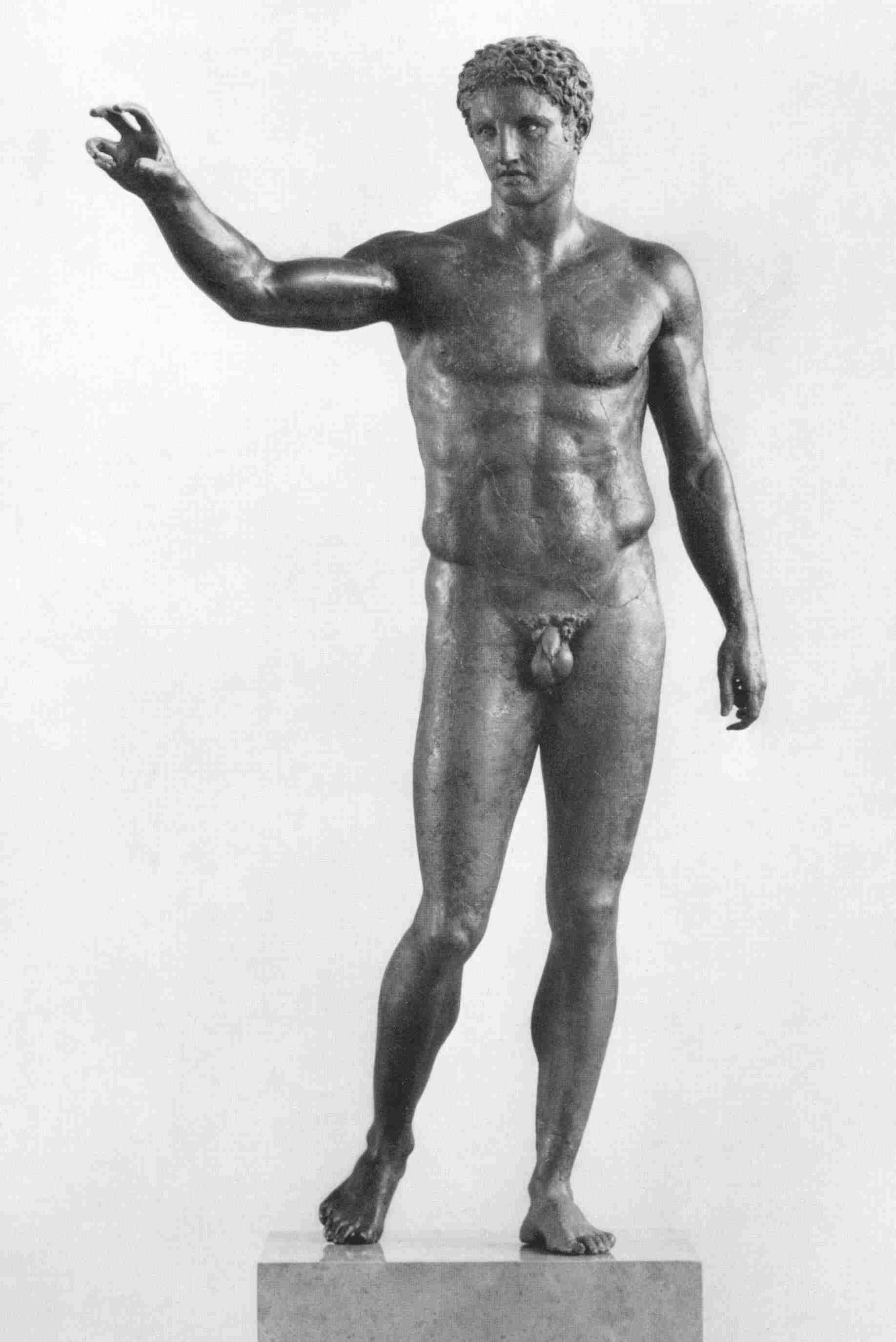
SEMI-TANGENT: The work of art historian Jas Elsner has interrogated the moment of Naturalism of Greek sculpture ("Classicism"), as opposed to the earlier dominant mode ("Archaism"), as a difference between the direct "gaze" of Archaic statues (here) and the "glance" of the classical style (here). The point is, for some reason, not looking at the beholder, came hand in hand with a new attention to really capturing and recreating the human form in a natural way. That is, the invention of the "fourth wall" is a kind of necessary or at least attendant invention with naturalism. Part of what makes it seem like life is that it doesn't know or doesn't care that we exist!
Hutchinson's staging in the round capitalizes on this glance in the most unpretentious way I've ever seen. Depending on where you sit in an early scene of seduction in the play, you are either treated to the singular journey of a man seducing a woman (whose face and indeed nudity are obscured) or the journey of a woman succumbing to an insistent lover (whose face and intentions are unseen). Fantastic. Moreover, since the set consists wholly of a bed that is rotated and locked into place by actors who sit in chairs onstage when not in scenes, even when we are drawn into naturalistic scenes it is always amongst the frame of a company of actors at work telling us a story. They never look at us or acknowledge us in the room, but they are not hidden to us as actors. So when their struggles are precisely the kind of quotidian, slice of life struggles of a thousand naturalistic plays, the content hits home much harder because they are shared by their presenters.
The second play was Mimesophobia in its Chicago premiere with Theatre Seven, directed by Margot Bordelon. This play by Chicagoan Carlos Murillo is ostentatiously presentational. Replete with two announcers/narrators, footlights, and actors who we are (with one fantastic exception) introduced as "not the real" character they are portraying. Part of the joy of this show which cleverly paints the struggle of depicting death through academia, Hollywood hackery, and its own ingenious theatricality is the fun the actors are having, but part of it is the way we see a complex intellectual concern that is entirely of our moment.
Lastly, this afternoon I saw Young Jean Lee's The Shipment. This breathless phenomenon is structured in three powerful and divergent acts that combine to evoke an unmissable statement about the African-American experience. The show is contemporary, magnetic, and its excellence is partly founded by the audience's ability to believe in and overlook the identity of its performers.
So. Recap. A completely amazing week on the theater front, bolstered by the certainty that life and living are more complicated than literalism demands. We don't need a "Long Day's Journey Into Hydrate" we just need to be cognizant of who directly we're engaging, not just the material, not just the matters, but the audience: why it matters now. There is an abundance of fresh genius for our stages. Enough even to compete with Beyoncé.
That's right, I brought it all home.
Tuesday, March 16, 2010
Tuesday, March 2, 2010
Sense
Logic and consistency may be two of the most overrated virtues of theater-making. So many hours are spent puzzling over aesthetic coherency and logical progression that it becomes really easy to think that these are inherent virtues of artistic expression, requisite for comprehension by the public. This is not so.
The number two song on the bilboard charts is this. I will say that it is arguably the worst song ever, but, importantly, it makes no sense. This has not slowed its overwhelming success. Certainly music, especially pop music, especially pop dance music presumes a different kind of audience engagement than two hours of theater, but there's still a lesson here.
And while I don't actually want to particularly valorize the kind of Theater of Moments that is popular with a breed of visual directors, productions that are a string of individually conceived bits that may or may not tie loosely together, it's important that they exist as an option. And it's worth remembering that the kind of ruthless tyranny of "logical consistency" is an aesthetic option rather than a moral requirement.
I hope you didn't click on the link.
Monday, February 22, 2010
Resolution, Cont'd
Of course, I don't mean to say that resolution should be abandoned entirely. And Zev is correct in a sense, that what I really seem to be arguing against is bad resolution, but it actually is a bit deeper than that. What I mean to offer is that the necessity to resolve is unnecessary, and I don't believe this is a particularly inflammatory suggestion. Zev's claim "entertainment seems to almost require a destination" is importantly not an intrinsic quality. It's based on historical data, perhaps, and perhaps on expectations, but that's different from aesthetic requirement. Isn't a rock concert entertaining? What's the resolution there? What's the narrative arc? And transporting only really obliquely demands a destination, i.e. not here. Meeting people who don't exist, caring about them, encountering their problems: this is transportive.
Anyway, it's not really that I want to abolish or sneer at resolving in general. The crux of my argument was this part:
...a lot of plays take a long time to get to what the "plot" is going to be. We spend much of the first act meeting the characters only to be presented with the "problem" of the play just before the intermission. The audience activity of the first act is replaced with the passivity of events unfurling in the second act, and this seems a shame.Well, doesn't it? When a play shifts to get "down to business" all we've learned of it so far changes from sum to background. The work we've done - audience participation in the real sense - becomes a down payment to the furtherance of a narrative we didn't demand. It's not that I don't like narrative, it's that I don't like this shift. I don't like being told to turn off. I don't need to watch a writer pat his own back for tying up all his loose ends. I just don't care. If you want to tell a story, tell a story. If you want to create a world and present problems, do that. If you want to do them both, do them both at once. But if you believe that you HAVE to resolve a story or you haven't made a play, you are wrong. Free yourself.
Abigail's Party, for instance (which you have to do yourself a favour and see), never has this shift, but it does have a narrative. The narrative consists of the accumulation of details throughout the play. There is no abrupt shift from exposition to narration, the play proceeds organically throughout. It also, brilliantly, doesn't have a resolution, it has a conclusion. A person could demand that the play have a third act, but it doesn't need it. The story has been told. The ingredients and the crisis have been presented, what happens next is not in the play.
Calls to Blood, on the other hand, did have an abrupt shift to narrative, but the point of the narrative was to make this tonal shift, and this shift did not serve to disengage but to reengage: what seemed to be a play about x is now a play about y. For this play a person did demand more scenes, but it doesn't really need it. The play doesn't tell the story of what happened next - that's not the play. Are there loose ends? ...Yep.
I know this all has a proscriptive tone, but what I'm arguing for here is more freedom rather than less. Forego the forced march. Enjoy the story you tell, don't feel obliged to resolve your plot for resolutions sake, or, especially, for my sake.
Resolution, Cont'd
Zev rolls his eyes at my previous post:
I think that a lot of the terms you mention theatre being about in the last paragraph imply a resolution, by their very nature. "Entertainment" seems to almost require a resolution--one of the primal points of storytelling seems to be the desire to give a narrative shape to life. Any work of narrative, even documentary, by its nature is shaped. It may not have an ending that perfectly satisfies (not all narratives are "Law & Order"), but it comes to something. To deny that primal desire seems perverse.
And if the purpose of theatre is to transport, doesn't that imply a destination? Most people taken on a trip wouldn't appreciate being kicked off the bus halfway through. If that's a conscious choice, it's one thing (some plays use that kind of dislocation very effectively), but it being negligence seems bizarre.
Now, that's not to deny that a good resolution is very hard to do well. Asking questions that are interesting through plot action is difficult enough. Resolving them in a satisfying way is rare. But simply the fact that resolutions are rarely done well seems like an insufficient reason to chuck them--plays are rarely done well, period.
Wilson Wants It All (and were you reviewing it? I'd love to read your thoughts in more depth.) is a pretty good example of a play where the ideas, the world, the staging, and the acting were all more compelling than the actual plot structure. Indeed, there were some pretty big plot and logic holes. At the time I saw it, they didn't bother me that much, but later thinking brought them out. I would still recommend the show--there's more to theatre than narrative--but that would certainly be a caveat.
So I guess my questions to you are: do you have a problem with resolutions as such, or just with poorly developed plots? And what would the art and the audience gain by not having them?
Friday, February 19, 2010
Resolution
Every book on play-writing ever written contains in some form an exhortation to resolve. Aestheticians ever argue this necessity on the grounds of narrative or emotional completion of the action presented, on the grounds, I suppose, that this is what the audience wants. Moralists (who, madder, more often capture my heart) insist that resolution comprises the civic legitimacy of the theater, that only by seeing horrors or pleasures rehearsed onstage can we be adequately prepared to face them in our own lives.
But: suddenly, recently I've found myself ambivalent about them. When reading plays at home I almost invariably put them down as soon as all the crises are in place. Of course I'll pick them up again and almost always be surprised - a good resolution is never a forced march no matter how inevitable it may seem - but nevertheless this is when my attention flags, when the pleasure turns to work.
Greek tragedy (and maybe Roman tragedy even more so) was based entirely on the struggle (moral, emotional, practical) between arguments over the course of action to take when presented with a problem. The conclusion - it's important to remember - was most often the least dynamic part, because, drawn from shared myths or recent past it was certain the audience knew where the story was going.
Today, of course, this is not at all true, and I understand the desire to tell a story with an ending and to watch a question that builds to an answer. Also, I've snarkily diagnosed the cliché of ambiguity that looms with self-satisfaction over the contemporary theater "of ideas."
So what's the problem? I think part of the reason I might find conclusions to be irritating is actually rooted in a different - almost opposite - problem. Specifically, a lot of plays take a long time to get to what the "plot" is going to be. We spend much of the first act meeting the characters only to be presented with the "problem" of the play just before the intermission. The audience activity of the first act is replaced with the passivity of events unfurling in the second act, and this seems a shame.
In The House's Wilson Wants It All (the first play in a while I've immediately wanted to watch again when the lights came up), for instance, the opening video is fantastic and the initial plot device is darling, the acting (particularly John Henry Roberts and Edgar Miguel Sanchez) is precise and exuberant and there's an eleventh hour speech that offers the most perfectly constructed villainy imaginable in America today, but for me the piece suffers in part from a desire to tie up loose ends and pursue the intricate but uncomplicated web it spins.
Why bother? I don't have any solutions for this, but, if theater is about entertainment, if it's about movement or transportation, if it's about recognizing humanity, if it's almost any definition you can offer, it can handily unburden itself from the need to resolve.
Wednesday, February 3, 2010
A Brisk Walk
From rehearsal to where I caught the Belmont bus home I walked by Strawdog, Oracle, Bruised Orange, The Playground, the Theatre Building, and the new Theater Wit space. That's 6 theaters in twenty minutes on foot, not counting Mary-Arrchie (right around the corner) or The Viaduct (I was, happily, already on the bus by this point). I'm probably forgetting one. Sure, I almost froze my mustache off, but, good God, I love this city.
Friday, January 29, 2010
Playhouse
I just got a call from my dad pointing me to this article, detailing news that a beautiful old theater in my hometown is closing its doors. I wasn't closely involved with the Playhouse (I was, for a short time, an usher), but it makes me sad to think of it not existing.
It looks like they're pausing to re-assess rather than just giving up the ghost entirely, and I hope that's true. It really is a phenomenal old space and, playing optimistic, this may give them the opportunity they need to think about how they can build a more sustainable model, and better serve and represent their community. If they want a mustachioed young director with ties to the community to come help out, I will say this: I'm cold. Pasadena? 67 degrees. Wind: Calm.
Arts-business heartbreak quote:
Eich said the playhouse had pinned its hopes on finding a donor who would give $5 million to have the 684-seat main stage named in his or her honor, but that never materialized.
Emphasis mine. (Hat Tip: LRN)
Thursday, January 28, 2010
Weview
This is super smart, and gets at the true democratization of criticism (rather than a republican, or "senatorial" model) that is possible and underutilized in the internet age. The critic's entire ethical legitimacy is derived from his or her position as an audience member - I really, really believe that. What gives me the right to review a show? My ticket, and that I used it. Surely, what makes Kris Vire a good critic is that he "knows something", but even more that he can communicate what he has experienced - what was done, how it was done, and whether it was worth the doing - but it's not his intelligence or his expertise that validates his position, it's where he was sitting last night.
This descriptive methodology of criticism, though, changes when a readership is removed from the equation. The more voices present in a conversation, the less "responsibility" an individual voice has. It is certainly true for me that what I say to a friend about a show (or write here) is different from what I write for TOC. There are technical reasons (word limits, decorum, evenhandedness, etc.) but also there's a fundamental generic discrepancy between a theater review and a theater response. The former is an act of analytical expression, the later is an instance of extroversion. We live in an extroverted world, in more or less than 120 characters at a time we bombard our every acquaintance with our thoughts and - this is what's new - reasonably expect an audience. Talking to yourself on the street is still strange, but talking to yourself on a computer - with hundreds more witnesses - is as natural as drawing breath.
What Oracle is doing here, then, is in encouraging extroversion, directing extant extroversion toward a desirable topic, and forging a campaign of ambitious multiplicity in an overwhelmingly disparate and hyperactive marketplace. I'm excited to see how it goes.
Wednesday, January 27, 2010
Overdue
Couple of articles around the web you should peruse...Full Storefrontal on Backstage and new Time Out review of I Am My Own Wife at BoHo.
Wednesday, January 20, 2010
Friday, January 15, 2010
Subscribe to:
Posts (Atom)


 Posts
Posts